Doctors Find Their Voices as Authors of Children’s Books
Four alumni share how storytelling can open young readers’ eyes to the possibilities of science
- 7 minute read
- Profile
Illustration: Nate Williams

Illustration: Nate Williams
The worlds of surgery, psychiatry, primary care, and emergency medicine seem far removed from the pages of a children’s book. But for four HMS alumni who are also children’s book authors, the callings of medicine and storytelling are deeply connected.
Rajani LaRocca, MD ’96: Telling the Truth
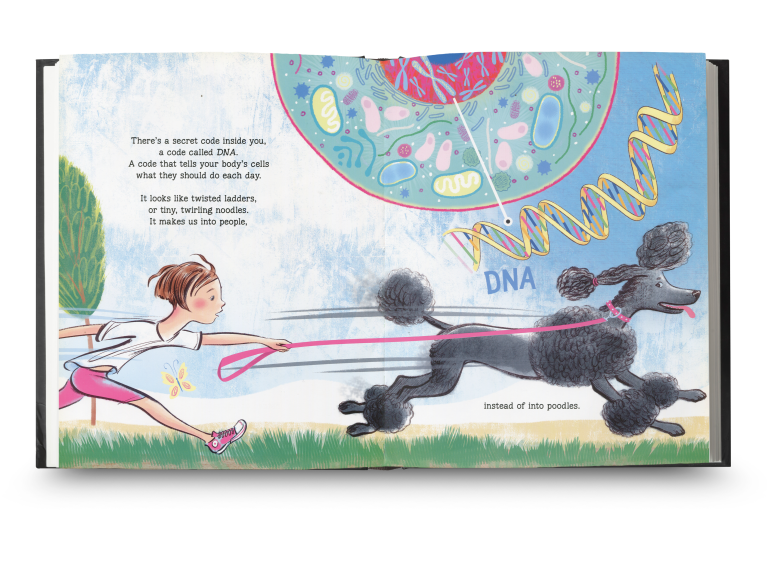
Excerpted from The Secret Code Inside You by Rajani LaRocca. Illustrated by Steven Salerno.
When young Reha looks at her life, she sees disconnected fragments. Reha, an Indian-American middle-schooler, is the protagonist in Red, White, and Whole, a 2021 verse novel by Rajani LaRocca, MD ’96, a primary care physician at Massachusetts General Hospital.
LaRocca uses snippets of Indian mythology, medical reports, scenes from a school dance, and other sources to tell the story of Reha’s attempt to navigate between the different worlds her family and friends inhabit. By the end of the book, Reha begins to see, in one of many evocative metaphors woven through the fabric of the story, that what she thought of as the distinct streams of her life were really a single body of water.
Reha’s story is a reflection of LaRocca’s own life growing up in Kentucky in the 1980s as an immigrant from Bangalore, India. The idea that all of the pieces of a person’s life coalesce into a complex but unified whole is a running theme in LaRocca’s work as a primary care physician and Newbury-Honor-winning author.
“Both of these careers — passions, really — involve loving and being very curious about people,” LaRocca says. “It’s all about storytelling.”
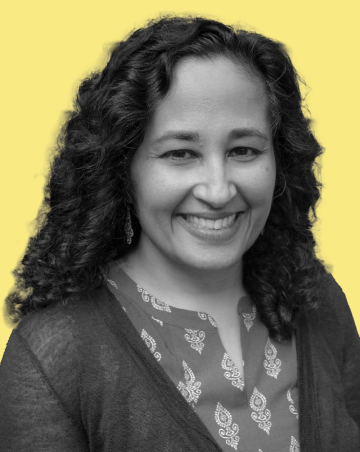
Photo: Carter Hasegawa
“My job as a physician is to help my patients live the life that they want to live for as long as they can,” LaRocca says. “Listening is an important part of that.”
Physicians are trained to meet their patients where they are and to understand how all the different pieces of someone’s life relate to their health and well-being, LaRocca says. Approaching that work without judgment is key to helping patients meet their health goals.
It’s also an important skill for writing realistic characters. “The thing about writing books for kids is that you have to tell the truth,” LaRocca says. “It’s hard and scary to do but there’s nothing as wonderful as when you get it right.”
LaRocca, who has published more than a dozen books, says she gravitated toward writing books for children because reading was such an important part of growing up for her. As she writes, she thinks about writing for her children and for the child she used to be.
The books she didn’t read are just as important as the books she read, she says, noting that she never saw someone who looked like her as the main character in a book she read until she was an adult. But as important as it is to her to reflect her own specific experiences in her books, she says that she really wants to highlight the things that people everywhere have in common.
Shan Woo Liu, MD ’00: Family Matters
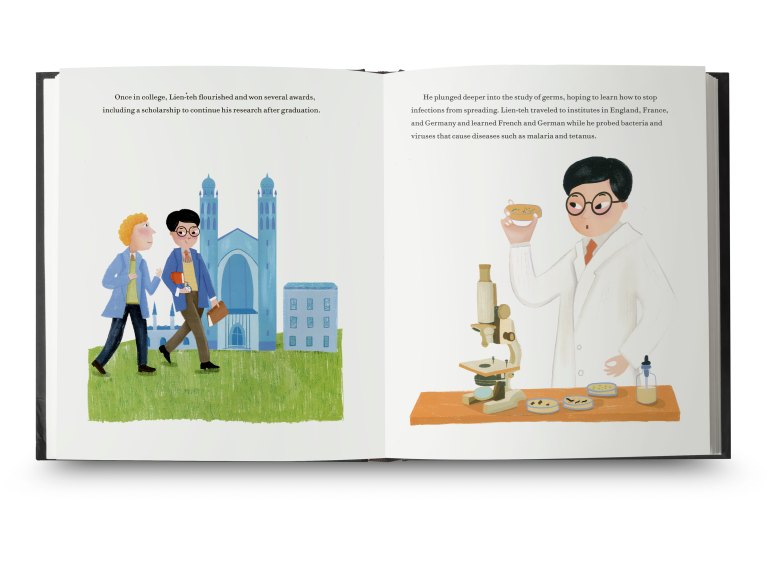
Excerpted from Masked Hero. Copyright © 2023 Shan Woo Liu. Illustrations copyright © 2023 by Lisa Wee Eng Cheng. Reproduced by permission of the publisher, Candlewick Press, Somerville, MA.
In the early months of the pandemic, Shan Woo Liu, MD ’00, was bewildered by the reluctance she saw from the public and from public health authorities to embrace masking. As an HMS associate professor of emergency medicine and an emergency medicine physician at Mass General, she wondered why no one was looking to Asia, where the outbreak started, for inspiration or guidance. And she was shocked at the wave of anti-Asian sentiment she witnessed. She asked herself how she could protect her family from the SARS-CoV2 virus and from the fear and racism that flared up alongside the virus.
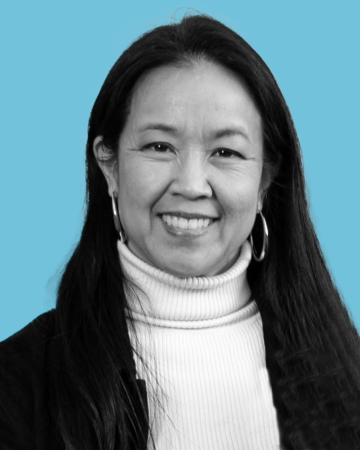
Photo: Kendal Bush
At the same time, she was struggling to keep her kids engaged in learning. She signed her first-grade daughter, Kaili, up for an online writing class. One assignment called for the children to write a story about a hero. Liu and her daughter set out to find an East Asian hero, as a kind of antidote to the anti-Chinese sentiment that was prevalent in the early days of the pandemic, but the only Asian hero they could find in a children’s book was Bruce Lee. Family members suggested that Liu tell Kaili about her great-great grandfather, Wu Lien-teh.
Wu Lien-teh was the first student of Chinese descent to study medicine at the University of Cambridge. Shortly after completing his studies, the young physician was called to help fight the 1910 outbreak of pneumonic plague in northeast China. To keep the disease from infecting all of the doctors and nurses, and ultimately the public, Lien-teh developed a multilayer cloth face mask that is the forerunner of the N95 masks that became the gold standard for preventing transmission of COVID-19. Just as in 2020, many of his colleagues were reluctant to use the masks until they saw that the people who wore them were not getting sick.
As Kaili started writing up Lien-teh’s story for her assignment, Liu realized they should turn the story into a book they could share with children everywhere. The result was Masked Hero: How Wu Lien-teh Invented the Mask That Ended an Epidemic.
Liu says that the process of writing, publishing, and sharing the book with readers across the country brought her closer to her daughter and helped her recover from the traumatic times that inspired them to write the book.
“Writing that book and working on it with my family was an outlet for all of my fears and frustrations and stress,” Liu said. “It gave me the hope I needed to hang on.”
P. Oneeka Williams, MD ’93: Empowering Children
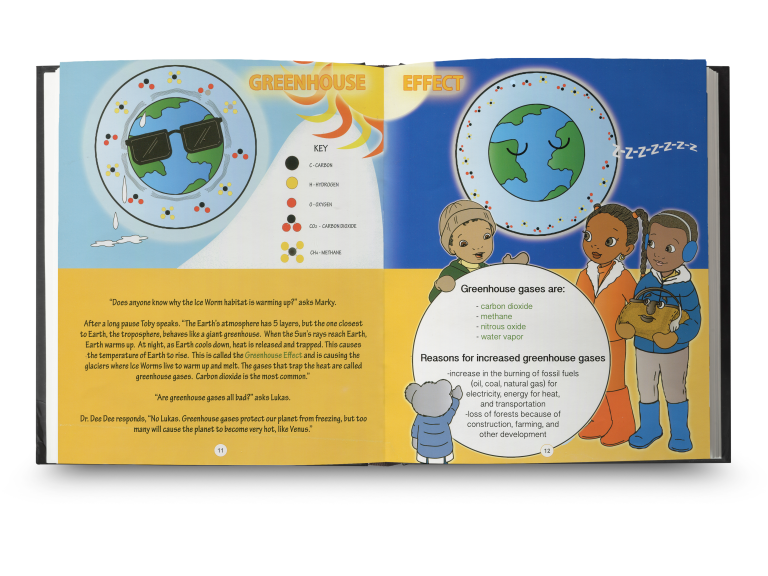
Excerpted from Dr. Dee Dee Dynamo’s Ice Worm Intervention by P. Oneeka Williams. Illustrated by Valerie Bouthyette.
After completing her residency and starting as an attending urologic surgeon, P. Oneeka Williams, MD ’93, was eager to do the most complicated surgeries possible. But as much as she enjoyed the mental, physical, and technical challenges of surgery, she felt like something was missing.
Williams started volunteering at Myrtle Baptist Church in Newton, Massachusetts, leading activities with the Science Club for Girls. One day, as the girls were working on a cow heart dissection, she described how the circulatory system works using the analogy of the New York transit system. The heart was Grand Central Station, the veins and arteries were train tracks, and the passengers were oxygen and carbon dioxide molecules coming and going.
“I could see the light bulbs of understanding going on,” Williams says. “Half the girls were freaked out by the heart and half were very engaged with what they were learning.”
Inspired by how using a simple metaphor brought the anatomy and physiology to life, Williams started to think about ways she could integrate her love of storytelling, literacy, and science to excite young people, especially girls, about science and later encourage them to take charge of their health.
Growing up in Guyana with no TV, Williams understood that reading is foundational to all learning. In 2012, she created a character named Dr. Dee Dee Dynamo, a girl super-surgeon on the go. Since then, Dr. Dee Dee and her friends have explored the rings and moons of Saturn; gotten to know the ice worms of Alaska; and taken on high blood pressure in Williams’ latest book, Hyper Tension Take Down!
Williams is also a frequent speaker in classrooms across New England and beyond. Her STEM books are used in science curricula in the United States and the Caribbean, and she dreams of expanding into school systems across the world to empower children with a positive mindset and excitement about science and equip them to take a role in their own health and the health of their families.
Whether she is taking care of patients in the clinic or performing a surgery as director of female urology at Emerson Hospital in Concord, Massachusetts, Williams says, she is filled with joy. However, when she combines her medical work with storytelling, making complex ideas simple, she feels as if she’s using all of the gifts that she’s been given, reaching across continents and generations to make a difference in people’s lives.
Justin Richardson, MD ’90: The Right to Read
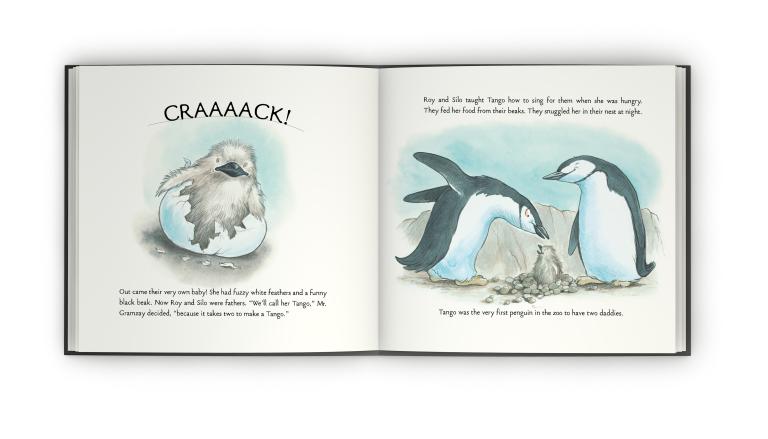
Excerpted from And Tango Makes Three. Text copyright © 2005 Justin Richardson and Peter Parnell. Illustrations copyright © 2005 Henry Cole. Reprinted with the permission of Simon & Schuster Books for Young Readers, an imprint of Simon & Schuster Children’s Publishing Division. All rights reserved.
One morning in 2004, Justin Richardson, MD ’90, and his husband, Peter Parnell, noticed a story in the New York Times about two male chinstrap penguins at the Central Park Zoo who had paired off, even attempting to incubate an egg-shaped rock they had found. A caretaker at the zoo gave them an abandoned egg. When the egg hatched, they raised the penguin — named Tango by the caretakers — together.
Richardson founded the Center for Lesbian, Gay, and Bisexual Mental Health at Columbia and now directs the Columbia University Center for Psychoanalytic Training and Research. Parnell is a playwright and television writer. Both knew immediately that the news story would make a charming picture book that could help people see the love at the center of a gay family.
Photo: Peter Parnell
That’s how the couple came to write And Tango Makes Three.
Although the book has been warmly received by many families and educators and won numerous awards, it has also been the subject of controversy that continues even today. In fact, over the past two decades, it has been one of the most banned books in the United States. “The right to read is under threat in America right now,” Richardson says. “As the fathers of a now- 16-year-old girl, we are determined to defend our daughter’s right to read and write and say what she wishes.”
Richardson and Parnell were honored with the Eleanor Roosevelt Award for Bravery in Literature on October 11, along with fellow honorees Margaret Atwood and Malinda Lo, among others.
Richardson knows firsthand what an important role children’s books can play in children’s development. His parents read The Story of Ferdinand to him many times when he was growing up. The book is about a gentle bull named Ferdinand who would rather smell flowers while the other bulls are smashing their heads together.
“I was a lot like Ferdinand, but my father was not,” Richardson recalls. The book helped him feel accepted for who he was.
“You don’t need to be trained as a psychoanalyst to understand that children need to feel seen and valued to grow up and be able to find love and live healthy lives,” Richardson says.
Jake Miller is a science writer in the HMS Office of Communications and External Relations.