Xenotransplantation Enters a New Era
As the waitlist for donor organs grows, Leonardo Riella sees animal-to-human kidney transplants getting closer to the clinic
- 6 min read
- Interview
Illustration: CSA Images/iStock/Getty Images Plus

Illustration: CSA Images/iStock/Getty Images Plus
In 1906, a French surgeon named Mathieu Jaboulay attached a pig’s kidney to the elbow of a woman with end-stage renal disease. At first, blood circulated between the patient and the kidney, and the organ even started secreting urine. But within days, the patient’s body rejected the organ, blood clots formed, and the transplant failed.
This is widely regarded as the first reported transplant of an animal organ to a human, a practice called xenotransplantation. A potential solution to the human donor organ shortage, xenotransplantation remained a scientific ambition for another century — but the incompatibility between species often seemed insurmountable. According to Leonardo Riella, the HMS Harold and Ellen Danser Associate Professor of Surgery at Massachusetts General Hospital, a cynical joke circulated in the medical community: “Xenotransplantation is the future of transplant and always will be.”
A few years ago, though, the nephrologist sensed a shift. Led by Tatsuo Kawai, an HMS professor of surgery and the A. Benedict Cosimi Chair in Transplant Surgery at Mass General, Riella’s colleagues at the Center for Transplantation Sciences had been using CRISPR gene-editing technologies to boost the compatibility of animal organs with that of potential hosts. They also had access to powerful new drugs that could suppress hosts’ immune systems to prevent the organs from being rejected. They transplanted pig kidneys into monkeys and watched the primates survive — not just for days or even weeks, but for years.
“That was, I think, the first time we realized that we’d cracked the code,” Riella recalls. “As a physician-scientist, my lens was, OK, let’s start thinking about how we can move this to the clinic.”
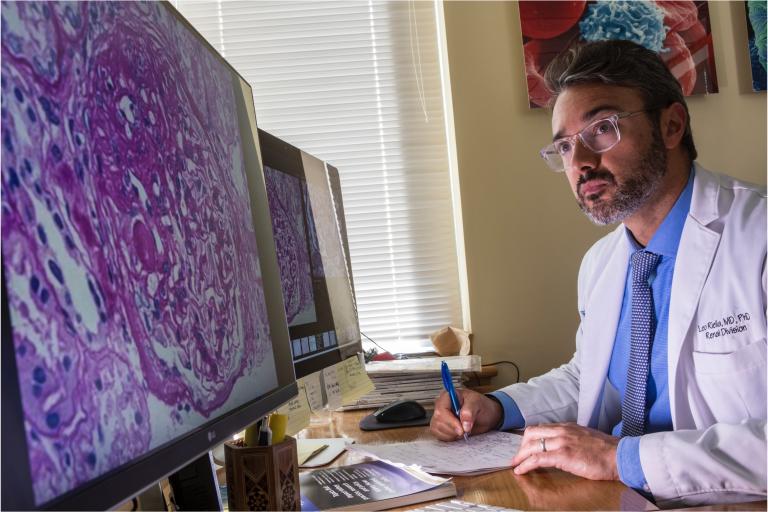
Photo: MGB Photography
In 2024, Riella helped lead the Mass General team that made international headlines for transplanting a genetically edited pig kidney into a human patient for the first time. Although the patient, Richard Slayman, died around two months later from a cardiac event, the case provided a rich source of data that helped the team successfully petition the FDA to move beyond single-patient cases and into clinical trials. In addition to collaborating on one of those trials — which will test the safety and efficacy of pig kidneys in patients over age 50 for up to 24 weeks after transplant — they are working with teams at other hospitals to establish consistent procedures and guidelines for xenotransplantation.
Harvard Medicine associate editor Molly McDonough spoke with Riella to learn more about how he and other scientists are managing the transition from isolated cases to coordinated clinical research and why he thinks that the “future of transplant” has already arrived. This interview has been edited for length and clarity.
It’s been more than two years since your team performed that historic kidney transplant. What did that experience teach you?
We learned so much. There were many unknowns, in particular the risk of zoonotic infection: the transmission of a new bacteria or virus from the pig into the human. We observed that with all the protocols that we have in place for monitoring — including screening donor pigs for pathogens and genetic approaches to eliminate certain pig viruses — we haven’t seen any of these infections. This has been a huge and positive surprise.
Also, our first patient had a cardiac event; he ended up passing from an arrhythmia of his heart. And while the kidney was still working, we couldn’t make the connection: Was it completely unrelated, or was there something about the pig kidney that might have predisposed him to the cardiac event? So, all subsequent patients get what we call an implantable loop recorder. It’s a small device inside the skin that monitors their heart rhythm continuously for four to five years after implantation. Fortunately, none of the subsequent patients have had any arrhythmias, which suggests that it was truly the heart of the first patient that unfortunately had a lot of changes going into transplant that made him more likely to develop an arrhythmia.
Now that you are moving beyond isolated cases like that one into larger clinical trials, what questions are you tackling?
When we first started, we didn’t know what to expect. We didn’t know if a pig kidney, once transplanted, would be able to maintain electrolytes like potassium and minerals in the same tight range as a human kidney needs to. We’re seeing in all these cases that the pig kidneys can have a thermostat exactly like a human one, that they actually work extremely well. It’s just incredible. All of this is helping us to figure out: How much do we need to monitor these patients? What are the things we need to provide attention to with a pig kidney compared to a human kidney transplant?
We also select a regimen of drugs that we give at the time of transplant. It’s an intense immunosuppressive regimen, because once you connect the new kidney, that’s when the immune response is going to be strongest. Once things level off, the biggest decision is what to adjust. We’ve started asking: What are the drugs we need to continue? What are the drugs we can start tapering or completely stop?
We’re sort of learning on the go. We, of course, get some knowledge from our prior human-to-human transplants, but some things are very unique to xenotransplantation.
It seems like there are so many unknowns, and at the same time, the stakes are so high for the patients who undergo these transplants. How do you handle making these decisions with patients without having a long track record of data?
Back in the early 2000s, we started a face transplant program at Brigham and Women’s Hospital, and I was the medical director. Our patients had very significant damage to their faces from burns and so on, and we were able to remove their faces and transplant faces from cadavers. This was not xenotransplantation, but the skin is one of the toughest organs to transplant; it has many, many more immune cells than any other organ in the body. One important piece I learned is that we must be transparent with patients that we cannot promise any results from these early studies because there’s no track record. We can talk about animal studies, but in theory, they’re in completely different realms.
These patients have an altruistic nature. They are willing to step forward and say, “Look, I want to be part of this. It may not benefit me, but I think it can benefit the field and other patients like me in the future.”
Our xenotransplantation patients also have a clear view that dialysis should not be the default treatment for people with end-stage kidney disease, which we also feel strongly about. Dialysis has been around for about 70 years. It’s an incredible treatment, but it was never meant to be permanent. There are more than 600,000 people in the United States whose permanent treatment for end-stage kidney disease is dialysis. These patients have a very accelerated cardiovascular mortality, and their quality of life is not good. They’re definitely looking for alternatives.
And then there’s the matter of the human organ shortage.
The organ shortage is one of the biggest barriers we have. At our hospital we now have 1,400 patients on the waiting list to get an organ. What does that mean? Once they get listed, they start at the bottom of the list and only time will bring them up. Some patients never make it to the top. More than half either die or get removed from the list because they’re too sick. We can assess them and say, “If we had a kidney today, we would provide the best treatment option and transplant you.” It’s a frustrating experience for us because we know what the best treatment is, but we can’t provide it in a timely manner.
Where do you hope to see the xenotransplantation field in 10 years?
I hope the two trials that are ongoing now — including one from our group together with a company called eGenesis — are going to prove that the treatment is safe and able to serve as a better option than dialysis. At this point, we’re not comparing a pig kidney with a human kidney; we’re comparing it with dialysis.
In the future, we will have access to better gene-editing technologies to make these kidneys even more compatible. It’s possible that we’ll be able to match and individualize them enough to even make them invisible to the human immune system. That would be a huge advantage because we wouldn’t need to use all the strong immunosuppressive drugs we currently have to use. It’s possible that one day, maybe 20 or 30 years from now, kidneys from pigs will be an even better option than human kidneys.
Molly McDonough is the associate editor of Harvard Medicine.