Is There a Crisis of Trust in Science and Medicine?
Surveys of shifting U.S. attitudes reveal concerning trends — and some surprises
- 8 minute read
- Interview
Illustration: Giacomo Bagnara

Illustration: Giacomo Bagnara
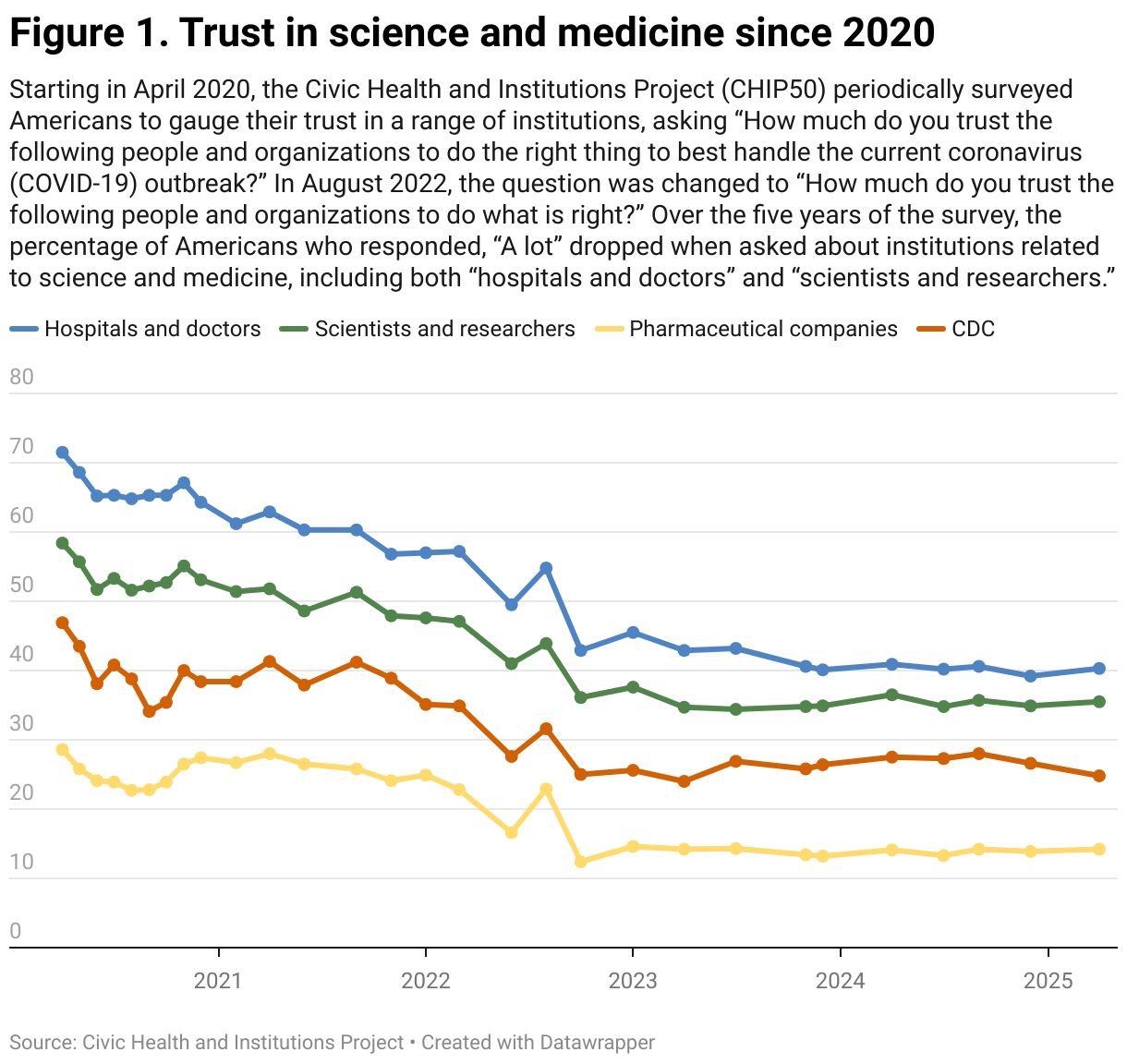
In April 2020, just a few months after the first documented case of COVID-19 in the United States, a survey conducted by a newly formed research group called the COVID States Project found that about 70 percent of Americans had a great deal of trust in doctors and hospitals to handle the pandemic. Yet over the course of the pandemic, the researchers found, that confidence steadily declined, even as the COVID-19 vaccines made their way through clinical trials and into the arms of most Americans.
By January 2022, when about three-quarters of Americans had received at least one dose of a COVID-19 vaccine, the percentage of Americans who said they had a lot of confidence in doctors and hospitals had dropped to 57 percent, and confidence continued to decline from there. In the most recent survey conducted by the research group (which is now called the Civic Health and Institutions Project, or CHIP50), in April 2025, confidence in hospitals and doctors stood at just over 40 percent. The decline in trust in scientists and researchers has been only slightly less dramatic, from 58 percent in April 2020 to about 36 percent in April 2025.
Roy Perlis, MD ’97, one of the principal investigators of the project, says the initial goal of this research was to gauge how reactions to the pandemic varied from state to state. “Individual states were handling the pandemic very differently,” he says. “We wanted to understand how people in different states were responding to all aspects of the pandemic.”
Over time, the researchers expanded their scope, but much of their work remained focused on understanding issues related to public health, including vaccination, the spread of misinformation, and trust in science and medicine. “A lot of what this project has been trying to understand is, first, what are people’s beliefs and behaviors, and, second, what are the factors that influence those beliefs and behaviors,” says Perlis, an HMS professor of psychiatry and vice chair for research in the Department of Psychiatry at Massachusetts General Hospital and editor in chief of JAMA + AI. “Why are levels of trust low? Why is it so easy for people to believe what is in many cases obvious misinformation?”
In the following interview, Perlis discusses what the project has revealed about the attitudes of Americans toward science and medicine. The interview has been edited for length and clarity.
After all the work you’ve done with the Civic Health and Institutions Project, do you think there is a crisis of public trust in science and medicine?
I’m not sure it’s just a crisis of trust in science and medicine. It’s a crisis of trust in institutions more generally. What we found during the pandemic was that levels of trust in institutions overall declined after some initial increases very early on. Still, most people trust hospitals and physicians more than almost any other institution.
But it is disconcerting, especially as a doctor myself, to see how much trust has declined. I think that is in large part a result of the spread of misinformation during the pandemic. There has been a concerted effort to cause people not to trust science and not to trust medicine. It has undermined people’s willingness to go along with public health recommendations, for example, and we’ll be living with the consequences of that for many years to come.
Was the pandemic a turning point?
Well, we were not surveying before the pandemic, but in general we’ve seen a decline in trust compared to historical norms, and I do think the pandemic was a turning point.
The reasons for that are complex. In part it was, as I said, an effort to undermine mainstream ideas about science and health. I also think we in the public health community did not help our cause by making very definitive statements that we then had to walk back. It is normal in science for hypotheses to change, but COVID was, for many people, their first exposure to how science works. I do believe you get to the truth, you get to the reality, but it’s not always an easy path. People saw — many of them for the first time — how science and medicine can really struggle to establish the best treatment or the best public health policy when we are scrambling to learn about a new disease.
A lot of the analysis of the decline in trust has focused on the growing politicization of science and medicine. Do you agree with that interpretation?
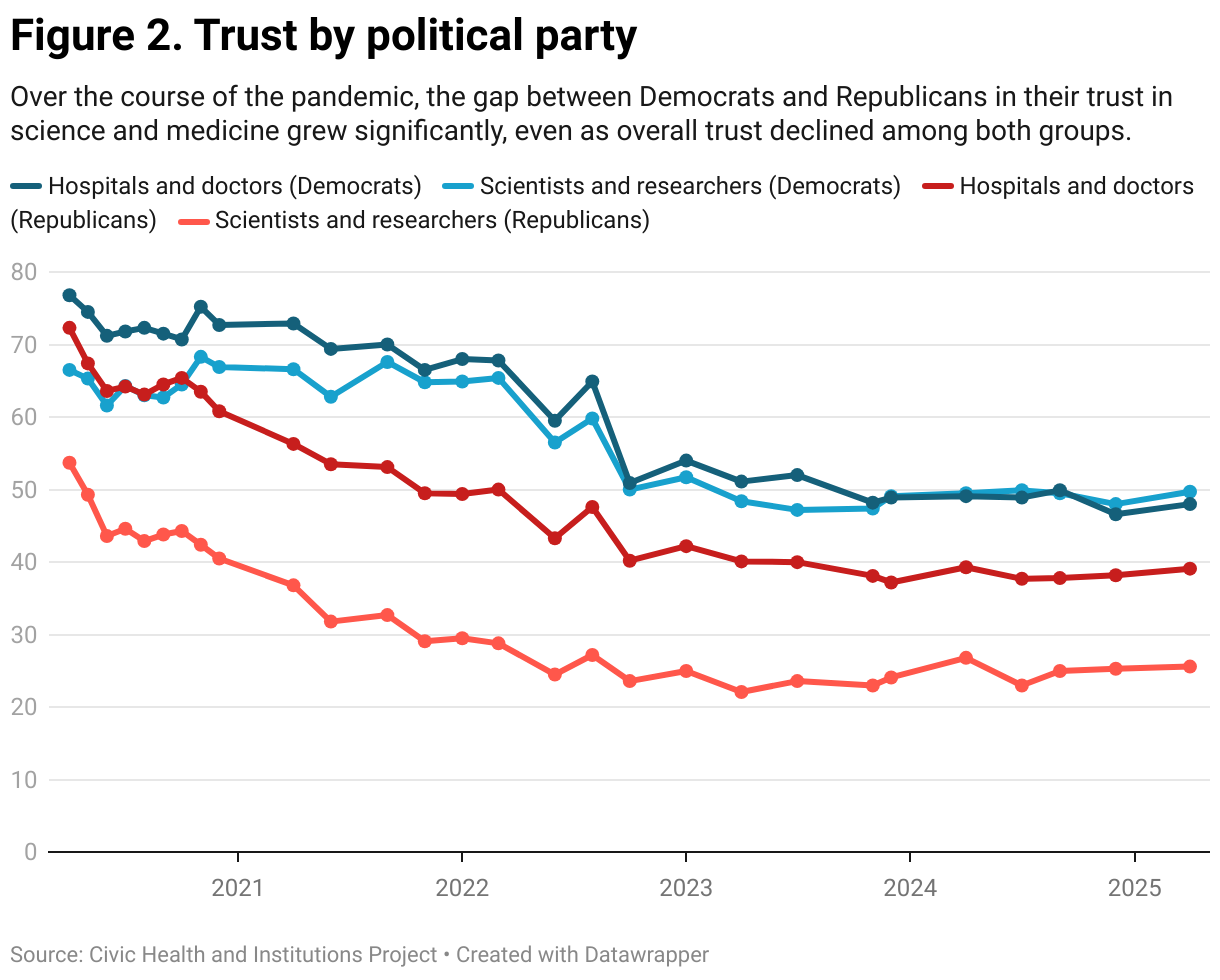
I think one of the many tragic things about the pandemic is the way science and medicine became politicized. There’s nothing about vaccines that is inherently Republican or Democratic. But suddenly how you felt about things like vaccines or wearing masks became a test of your political affiliation. It didn’t need to be that way. Science really is science. But politics became a shorthand for beliefs about COVID.
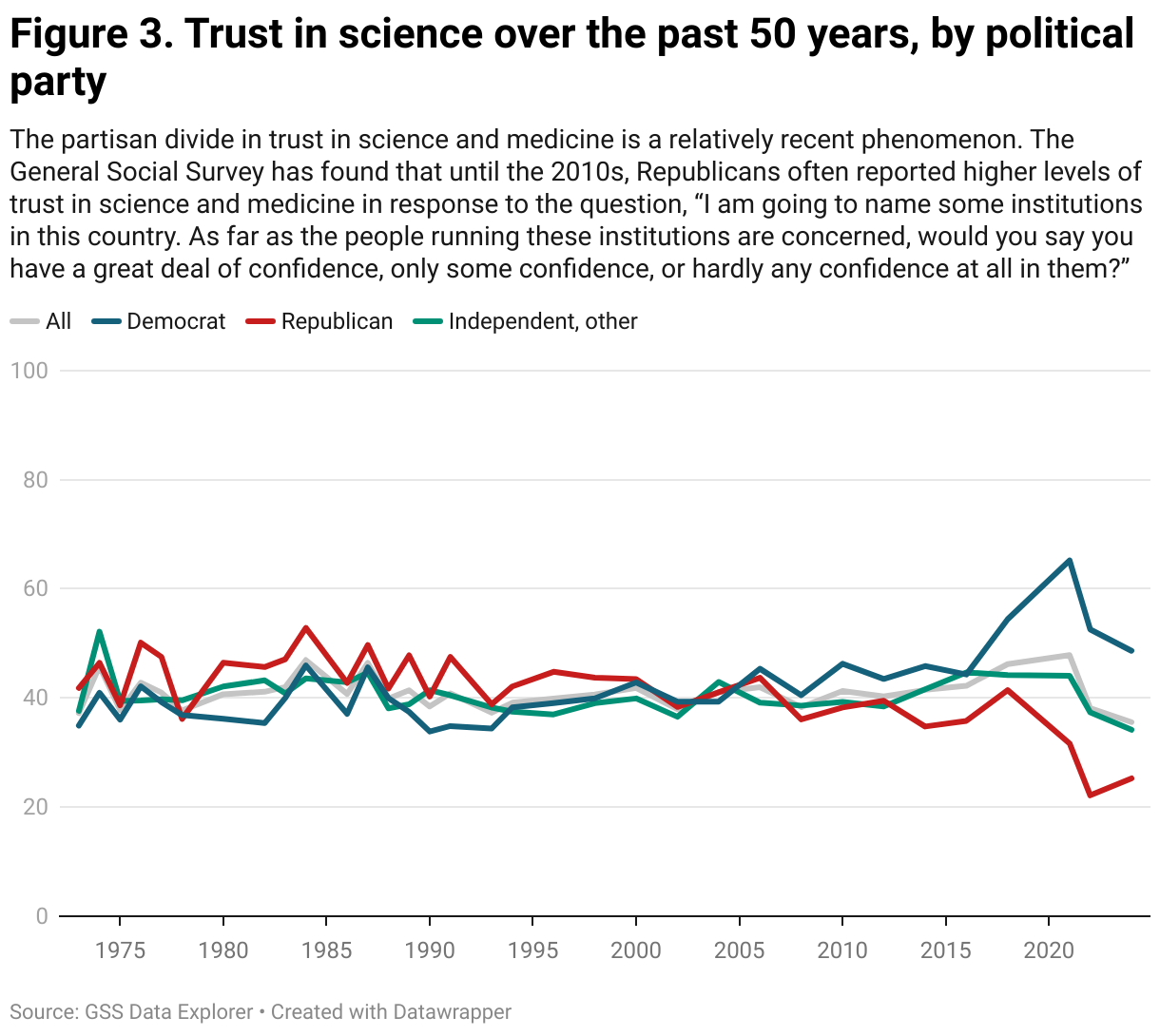
In an analysis based on General Social Survey data, you noted that there are longstanding differences in trust by demographic group. Do you think that is a different problem than the more recent issue of the partisan gap in trust in science?
There is huge variability in trust across different communities that long predates the pandemic. If anything, the pandemic just catalyzed people’s anxieties about medicine and about scientists. The lack of trust really came more out into the open, which isn’t necessarily a bad thing. If we acknowledge it, we can at least work on it.
In one of our papers we asked people who indicated low levels of trust why that was. What was eye-opening was that a lot of the responses had to do with a fairly small number of themes. One theme was that they didn’t trust doctors because something bad had happened to them or a family member. Another set of reasons had to do with mistrust of the institutions — doctors and hospitals are just in it for the money, so I can’t trust what they say.
Photo: Matt Kalinowski
Regarding that first answer — people’s loss of trust because of something specific — it is really on the entire medical community to think about how we handle it when we make mistakes or when we have a bad outcome. The second answer — that doctors have ulterior motives — is in many ways more complicated. Why is it that so many people believe that doctors are motivated by something other than concern for the patient? There are a lot of possible reasons that have nothing to do with the pandemic. I suspect a lot of it has to do with the fact that now it’s not me and the patient in the room; it’s me and the patient and the insurance company. Patients perceive that.
I wish there were straightforward answers, because it would be much easier for us to address the problem of trust, but this is a case that really defies a simple black-and-white answer. I think it has to do with a lot of juxtaposed changes over time. I would add that one of the interesting things I’ve noted in our studies, and also anecdotally, is that a lot of people say, “Well, I don’t like doctors, but I like my doctor.”
You also found that people are not very good at estimating how much trust those in a different political party have in science and medicine. For Democrats, in particular, there was a huge gap in perception — they tended to think that Republicans have much less trust in science than Republicans actually reported. What did you take away from that finding?
It really highlights for me how people’s beliefs about other people with different political beliefs have become very hardened. We tend to exaggerate those differences. We have these very fixed ideas about how different other people are. And when you actually do the study, you find out their ideas aren’t that different.
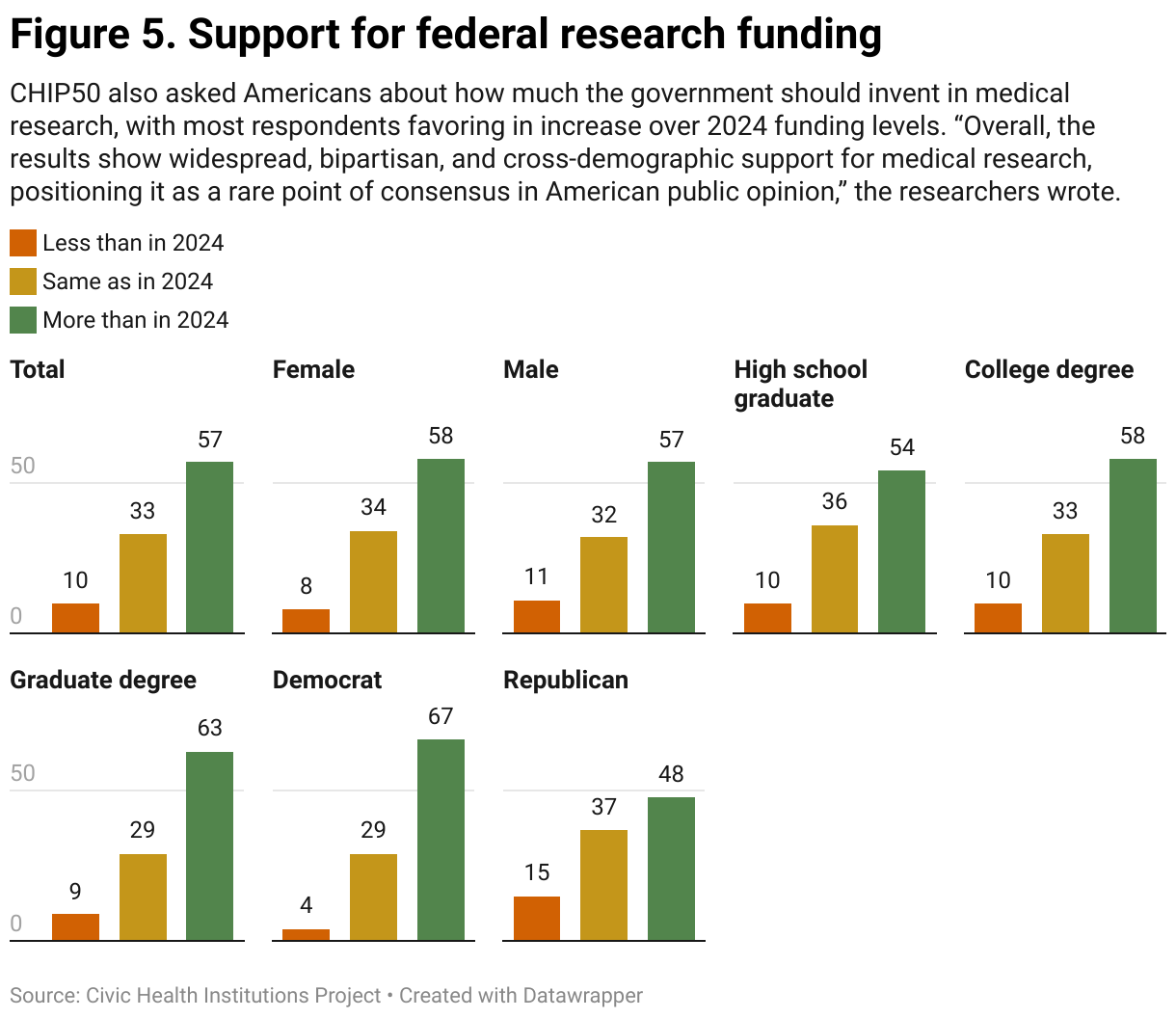
You have also looked at reactions to recent federal government actions related to science, showing that far more Americans disapprove than approve of these actions and that far more Americans favor increases in medical and scientific research funding than favor decreases. How do you think those findings fit with the overall decrease in trust?
I think it’s another illustration of our tendency to caricature groups that we see as different from ourselves. I would venture to say that if you ask most Democrats, they’d say that Republicans don’t support research. But what our survey shows is that even in very red states there’s strong support for funding medical research. Many people believe we should fund more medical research and strongly disapprove of cutting funding for medical research. It is true that in general there are lower levels of disapproval for cutting funding among Republicans than Democrats. But by and large, across states and across politics, Americans support increasing funding for medical research.
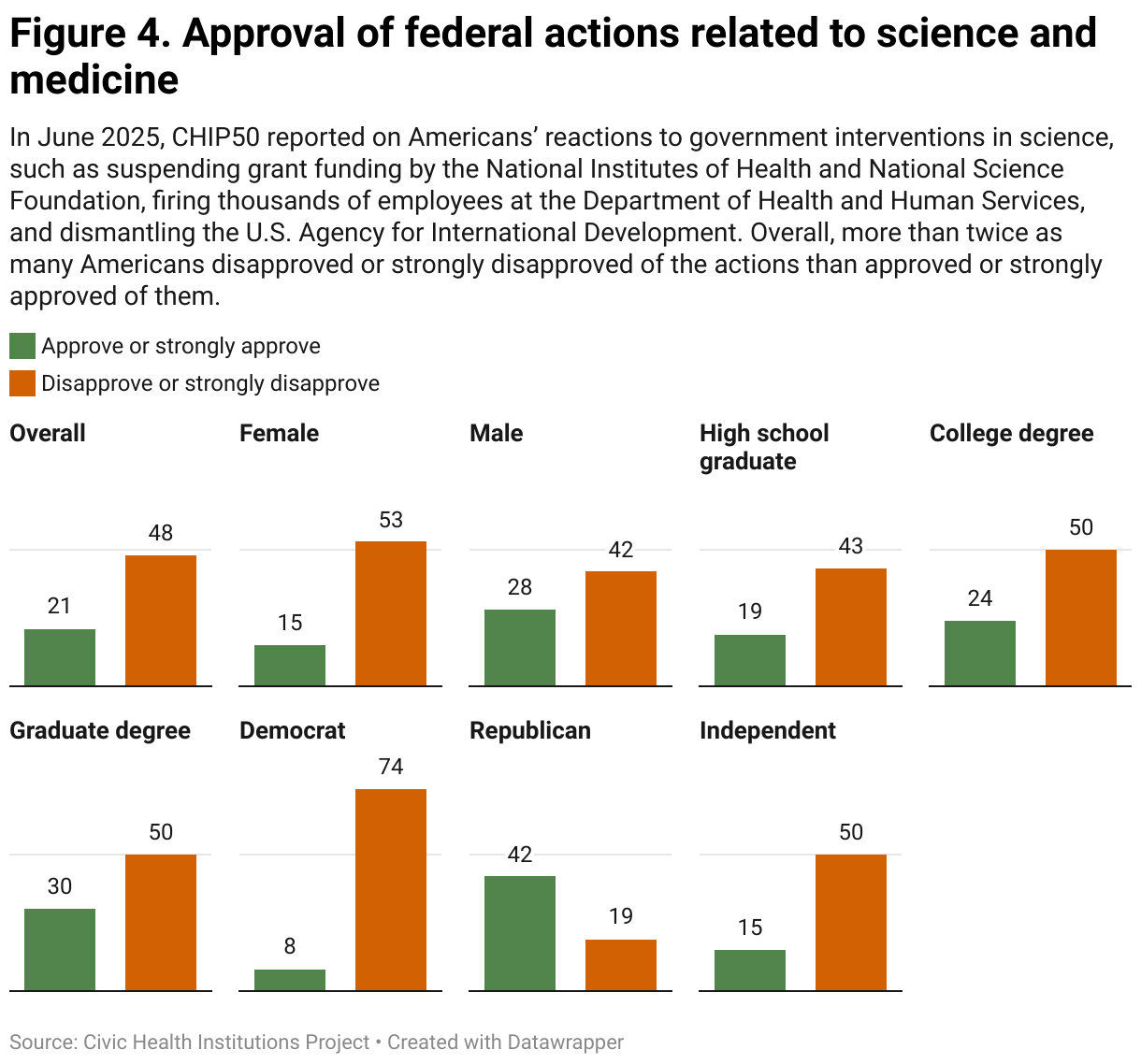
I was surprised to see that there was only one state where even 10 percent of respondents strongly approved of the government actions to cut funding for medical research.
When you get down to it, everybody has friends and family that they worry about, and most people recognize that the only way we’re going to get better treatments is to invest in research. What’s heartening to me, is when you slice and dice these numbers by age, by gender, by race, by geography, by political affiliation, levels of support for funding medical research are quite high across those groups.
What’s the role for scientists and physicians in the current climate?
That’s a really hard question. I don’t think we know the answer. The U.S. scientific community has not found the right way to respond to clear threats to science and health. We know we have to do something, but it’s not clear what we can do that’s not going to make it worse.
To take a step back, I’m a psychiatrist, and I know that you can’t just talk people out of ideas. If someone comes in to see me and they’re depressed, I can’t just tell them, “No, you’re not depressed. Your life is actually pretty good.” If someone comes in with delusions, I can’t just tell them, “No, you’re wrong. Actually, this is true.”
It’s far more valuable to try to understand why someone thinks the way they do. I am not saying we shouldn’t correct misinformation, but we also need to understand why people get so attached to certain ideas. How much does social media matter? It turns out social media matters a lot. Does your community matter? It matters a great deal. How much does misinformation matter? It turns out misinformation mattered a lot during the pandemic, and there’s no reason to think it matters any less now.
I would say again that while we certainly see political differences in a lot of measures, there are many areas where there is a fair amount of consensus about what people would like to see happen, including investing in medical research and science. That is both reassuring and heartening.
Amos Esty is the editor of Harvard Medicine.