The View of Health Care From the Oval Office
David Blumenthal discusses his new book, Whiplash, which covers 15 volatile years in American health care policy
- 7 minute read
- Interview

Photo: Douglas Rissing/Getty Images
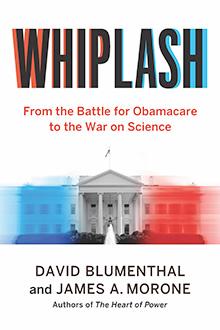
In 2009, as the battle over the Affordable Care Act heated up, David Blumenthal, MD ’75, and James Morone published The Heart of Power, a history of the presidential politics of health care from Franklin D. Roosevelt through George W. Bush. Now, in Whiplash: From the Battle for Obamacare to the War on Science, they pick up the story where they left off, describing how health care took center stage during a tumultuous time in American politics. “The story you are about to read might be summed up in one word — whiplash,” they write. “Three presidents, as different from each other as they could be, led the country to very different places so fast it has whipped our heads around.”
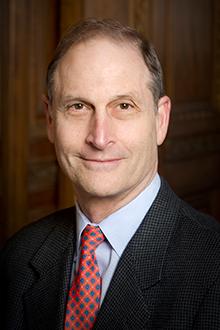
Blumenthal, the Samuel O. Thier Professor of Medicine, Emeritus, at HMS, has been interested in the intersection of health care and presidential politics since he studied with the legendary political scientist Richard Neustadt as an undergraduate at Harvard in the 1960s. While a medical student at HMS, he also earned a master’s degree in public policy from the Harvard Kennedy School. Early in his career, he served as a health policy staffer with Senator Edward Kennedy, and he went on to advise both the 1988 campaign of Michael Dukakis and President Barack Obama’s 2008 campaign. In 2009, Obama appointed him the national coordinator for health information technology, a role in which he oversaw the push to encourage the adoption of electronic medical records. Blumenthal also spent years practicing as a primary care physician, giving him an unusual vantage point from which to understand the health care system at every level. To write both The Heart of Power and Whiplash, he partnered with Morone, a political scientist at Brown University who was already the author of multiple books on American politics.
Blumenthal talked with Harvard Medicine editor Amos Esty about what he has learned about presidential leadership and the political forces that continue to shape the American health care system. This interview has been edited for length and clarity.
When you were a medical resident in the 1970s, you took a leave to work on the staff of Senator Edward Kennedy. How did that experience shape your view of the politics of health care?
First of all, it acquainted me with legislative politics and the dynamics of Capitol Hill. Second, I watched a brilliant politician try repeatedly to put together coalitions that would bring about health care reform. I think it made me appreciate much more the size and diversity of our country and the challenges at the national level in trying to accomplish major health care change.
Another deep influence was my time working on the Dukakis campaign. There’s nothing like traveling on the plane of a presidential candidate to instruct you on how big this country is, how complicated it is, how often health care is not the primary issue on people’s minds, and the importance of taking risks if you want to accomplish big things in American politics.
Whiplash is the second book you’ve written looking at health care through the lens of presidential politics. What is it about that angle that you find so compelling?
Well, presidents have a huge role to play in health care, and that role has been understudied. I was sure they had great stories, and I thought as a physician maybe I could find a link between their personal health, their family’s health, and their health care choices. That was the stimulus for me to begin working on this several decades ago, which led to the first book [The Heart of Power].
At the point we finished the first book, health care had really receded on the national agenda, partly because of the failure of the Clinton plan. I wouldn’t say that Democrats had lost interest, but they’d lost the courage to bring it forward as a major issue. Then suddenly Barack Obama brought it back to life. So we really felt we needed to go back and look again at the presidency and health care.
You note that Democratic administrations had been trying since at least FDR to pass some sort of national health insurance. What was different about either the conditions of 2009 or Barack Obama that enabled passage of the Affordable Care Act?
I think it was partly Obama’s passionate commitment to this issue and partly the fact that he ended up with a filibuster-proof majority in the Senate and a very strong majority in the House. It was a blue moon event, as my colleague Jim Morone is fond of saying.
It was also that Americans were ready for some change, that the problems with cost of care and access to care had ripened to the extent that a strong Democratic majority was willing to take the risk of advancing major health care reform.
At the end of your previous book, you lay out rules for presidents who want to take on health care. Did anything about your research on the Obama, Trump, and Biden presidencies change your understanding of how presidential power works?
No, I think the lessons were reinforced. The critical lessons are to know what you want, set priorities, act fast, come in with a plan, be passionate, know how to lose, and let Congress take the lead within clear presidential guidelines. Both Biden and Obama did those things.
There’s a story in the book where Biden is trying to get [Senator] Joe Manchin over the line on health care. Biden is so comfortable in the Senate in that way. He is a person of the Senate. He is spending a lot of time on the details of the Inflation Reduction Act. And finally, he says to himself and his staff, ‘I’m behaving like a senator. That’s not the way I ought to be behaving. I have to step back and let my allies in the Senate do the negotiating,’ which is what he did. I think that was a moment of realization that the executive branch has to give the legislative branch the space to feel like it’s empowered, at least in normal presidencies.
You and Morone write that you were both excited when Obama was elected and didn’t see the whiplash coming, the anger that many Americans felt about the Obama presidency. Was that a blind spot generally within the Obama administration?
I think it was. Who predicted the depth of antipathy toward President Obama and whatever it was about his presidency that caused the counterrevolution that has occurred with the first and second Trump terms? I don’t think people on the progressive side of politics or even in the center anticipated the Tea Party.
Another major topic you write about, of course, is the COVID-19 pandemic. Did debates over the Affordable Care Act shape the politics of the government’s response to the pandemic?
I’d say no, not directly. I think the debate shaped the tenor of American politics. It coalesced sides in the culture wars and the discontent of people who felt disenfranchised. Even though the Affordable Care Act was aimed at making life better for lower-income and middle-income Americans, they didn’t feel it in ways that were important. I think it created a rawness to politics that the pandemic fed upon. So at a kind of fundamental level in the development of American politics, yes, it did have an influence, but it had no direct influence because pandemic politics are so unusual in the history of countries like ours.
Now, it turned out that President Trump consciously mobilized the cultural discontent of Americans as part of his effort to neutralize COVID as an electoral issue. That was one of the legacies that he left of his first term — the perception that public health and science are part of an elite, progressive, coercive part of the American political scene. And we are living with that right now.
In addition to all your work in policy, you practiced medicine for years. Did you feel that these two worlds understood each other?
No, not at all. I had enormous respect for my clinical colleagues, but, with a few exceptions, I didn’t feel that they understood this other world in which I circulated. I didn’t attempt to bring that world to them. I didn’t see the point in constantly trying to bridge that chasm. When I was in my clinical and research role, I was in the clinical and research culture. When I was in these other worlds, I was bringing my clinical understanding but also trying to understand what the realities were of the people I was advising and working with in politics and government.
Did people in politics and government understand what it was like to be a physician in the health care system?
No. But I saw the extent to which politicians often do respect health care professionals and are willing to listen to them if they can talk in ways that the politicians can understand. When I mentor young people, especially people who want to be politically active, I often say that physicians should just show up in the statehouses if they have strong views. Make appointments with their state legislature, bring their white coats, and they’ll get a respectful hearing and a grateful hearing. I think clinicians underestimate the receptivity of politicians and also underestimate how little those politicians know about the day-to-day work of clinical care.
You make the point that this 15-year period you’re writing about is an anomaly in American history, in that health care has been a prominent issue for such an extended period of time. Is that coming to an end?
Well, it depends a lot on presidential leadership. I do think that health care will continue to be an issue, but within what Jim Morone calls between the 40-yard lines — we’ll see conflict over how generous the existing statutes should be, how big the subsidies for purchasing insurance should be, how restrictive the qualified health plans should be.
I think we’re some ways away from what is going to be required, which is another very significant reform effort to contain the costs of health care, which we have been unable to do since the 1980s when our costs began to diverge from those of most other high-income countries.
Do you think it’s going to take another president who’s willing to, in some ways, sacrifice their administration?
Or it will take a level of discontent on the part of the American people that will force a president to take that risk. It will be a different process, because it’s going to be about disciplining the system as much as extending coverage. The politics of containing costs are different. If you put limits on what’s covered or on who you pay to provide services, it means potentially taking something away rather than extending coverage. It might be an even nastier debate than the Affordable Care Act.