Your Gut Is a Brain
Trisha Pasricha talks about her new book and her lifelong obsession with the gut
- 8 minute read
- Interview

Trisha Pasricha
Photo: Niles Singer/Harvard Staff Photographer
In 2005, when she was still in high school, Trisha Pasricha made national news for a science fair project in which she tracked electrical signals in the gut to improve on standard lie-detector tests. It was a sign of things to come.
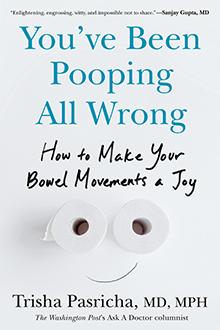
More than 20 years later, now an HMS assistant professor of medicine and a neurogastroenterologist at Beth Israel Deaconess Medical Center, Pasricha remains both deeply fascinated by the gut and a regular presence in the media. In addition to writing the “Ask a Doctor” column for The Washington Post, she has a devoted following on social media and is often quoted about popular health topics in the news. And now she is the author of a new book, You’ve Been Pooping All Wrong: How to Make Your Bowel Movements a Joy.
“Forty percent of Americans’ daily lives are disrupted by their bowels, and 15 percent have irritable bowel syndrome,” she writes. The book offers both advice on a wide range of poop-related ailments and anxieties and a deep discussion of the science of the gut, drawing from the latest research, including her own, to explain what we know about the gut-brain connection.
In her clinical work, for example, Pasricha noticed that many of her patients with Parkinson’s disease mentioned having ulcers when they were younger. Intrigued, she pored over thousands of patient records and found that ulcers and other gastrointestinal injuries were associated with a 76 percent increased risk of the disease. It’s one of many findings Pasricha discusses in her book that call for a rethinking of the gut-brain relationship.
“What we’re learning about Parkinson’s disease is shedding light on other diseases,” she writes. “Perhaps put more simply, the gut is telling us something about the human body that we never realized before.”
Pasricha talked with Harvard Medicine editor Amos Esty about her new book and her obsession with the gut.
You conducted that science fair experiment when you were in high school. Your father is a prominent neurogastroenterologist. And, as you point out in the book, there’s the matter of your initials. Do you feel like you’ve been preparing your whole life to write this book?
I did feel that way. I’ve had this book in me for a long time. I’ve wanted to address and normalize and destigmatize the conversation since I became a gastroenterologist. But the part about the science of the gut-brain connection, that’s been brewing for years, even since childhood. I wanted to share all of that cool science.
People sometimes say, “Why did you go into GI? It’s a gross field. You must love poop.” Actually, I’m not obsessed with poop per se, but I am obsessed with the gut. I think that if you grew up the way I did, which was hearing about how our bodies work and how the enteric nervous system interacts with our central nervous system — that’s so cool. I think it’s the most exciting field, I would say in medicine, but at the very least in GI. We know a lot about how the gut and the brain communicate with each other, but we also don’t know so much.
You’ve been doing a lot of interviews lately, and it seems like you’ve struck a nerve. People are really excited to talk about the logistics of pooping.
It’s surprising in a way, and then also absolutely not surprising to me. It’s why I knew I could write this book and should write this book. It’s something that is treated as so shameful, as something we should never talk about in public. But I discovered both as a clinician and in my writing for The Washington Post that whenever you offer people a window of opportunity to talk about their guts, you open the floodgates. People want that information.
Do you think the role of the gut has been underappreciated in overall health and well-being?
Yes. I think most people still believe that the gut is just plumbing. It’s just this tube that transports food from point A to point B. People don’t treat the gut like a brain, which is the way I think of my gut and treat my gut. I think every neurogastroenterologist thinks of the gut as this brain. It is this remarkably sophisticated organ that you have to protect at all costs.
We know some foods are good or bad for our health, but we’re not thinking like, “What I’m putting into my body is going to have immediate consequences on this very delicate, sensitive brain.” That’s a frame shift that I hope the book gives people. Your gut is so much more than plumbing. Everything you do, whether it’s your thoughts, your mood, what you eat — all of those things will have a big impact on your gut. And then in turn, that is going to influence all those other aspects of your health.
Do you think that’s changing? Fiber seems to be having its day.
Fiber has come back. Protein was really big and then everyone got into “fibermaxxing” lately, which is a trend I’m totally here for. But what I fear is that at the end of the day, we’re still going to find that most people are not meeting their fiber goals. The latest data is that 95 percent of Americans are not meeting their fiber goals.
You’ve been involved in medical journalism for a long time. What have you learned about communicating with the public about complex scientific topics?
It’s hard. What I love about the Post column is that I have about 800 to 1,000 words to really dig deep into a topic, and then I can link to multiple sources that back up even more in detail what I’m saying. When it comes to social media, you have three seconds to hook somebody to want to watch. You have 60 seconds to get one message across, and you have to find some way to pack in all that nuance that you would’ve had a lot more time for in a column.
I have a love-hate relationship with social media. I only got on it two years ago, and the only reason was because I read this really disturbing statistic about how the majority of Gen Z is getting their health information from TikTok. So I got on social media so that I could ask the questions that people want to ask and to be, I hope, a voice that is bringing in the science. But even for myself, I try not to spend too much time on social media because it’ll really suck you in.
When you see patients, are they coming to you with bad information about gut health?
Yes. Having done this, I tell my other colleagues that they should look at what patients are looking at. They should type in “gut health” or “IBS” on TikTok, because you’d be surprised how many times a patient will come in and they are trying some of the latest trends, like supplements and juice cleanses. And they don’t necessarily engage with you unless you indicate that you know what they’re talking about, you’re familiar with it, you’re not judging it.
So usually I say, “What have you tried that you might’ve seen on social media for your symptoms?” And it’s almost never nothing. But if you don’t ask, they won’t tell you because they assume you’re a traditional doctor who will dismiss this kind of stuff.
You write about research on the relationship between the gut and risk of developing Parkinson’s disease. What’s currently understood about that link?
The part that’s more strongly established is that there is a subset of patients with Parkinson’s for whom the disease originates outside the brain, and the gut is one of those places. The olfactory bulb has been discussed as another possible pathway. The hypothesis that Parkinson’s disease can originate in the gut was first proposed in the early 2000s. Then it was shown in a series of experiments to be the case that indeed the alpha-synuclein protein can misfold and propagate in this very reproducible staged fashion through the vagus nerve up to the brain. So that part is known.
The part that we’re all trying to figure out is what triggers the alpha-synuclein protein to misfold. I think most of us are starting to appreciate that even though the hallmark of Parkinson’s disease is misfolded alpha-synuclein protein, we don’t know that that’s the end of the story. There are probably other triggers that have nothing to do with alpha-synuclein that are contributing to the disease. We don’t fully know what those triggers are yet. There are hypotheses. People have talked a lot about pesticides on the foods we ingest.
I studied ulcers because of this interesting pattern I recognized with patients who were saying, “Yeah, I did have these ulcers back in the day.” It was just a question I started asking them, and it felt to me like more of my Parkinson’s patients were saying that they had them than the non-Parkinson’s patients. And then I found this old paper that noted a link, so we decided to do a big study. What we found is that people who had these older gastrointestinal injuries were later at a higher risk of Parkinson’s. I don’t know if that’s the trigger that caused the Parkinson’s or whether people who are destined to get Parkinson’s are more likely to be susceptible to injuries earlier on.
What’s an even bigger black box, one my lab is trying to study right now, is how dopamine signals in the gut influence dopamine signals in the brain. We already know so much about dopamine in the brain, but its role in the gut is so different. It acts more like a hormone and is involved in protecting the lining of the gut. It can actually be involved in suppressing tumor formation. It doesn’t cross the blood-brain barrier, but dopamine in the gut could indirectly upregulate or downregulate dopamine in the brain. We just don’t understand well enough how these systems are communicating.
I have this hypothesis that maybe some early changes in dopamine in the gut could be what indirectly causes changes in the brain, almost as a kind of compensatory mechanism to these injuries. That, ultimately, might be what leads to Parkinson’s. My five-to-10-year plan in my lab is to understand those questions.
Beyond Parkinson’s, you talk a lot about the effects of the gut on the brain. What would you most like to know about that connection?
I wish we knew more about how and why the gut ages and how the aging gut influences the aging brain, because these two systems are obviously very closely connected. People have invested a lot of time studying dementia and cognition as we age. Very few people have studied the role of the gut in that process. And my work in Parkinson’s is kind of a small piece of that much bigger puzzle.
You cover a lot of ground in the book, but one thing you do not mention is that you have an asteroid named after you. How did that come about?
Thanks for bringing up my asteroid. Basically that was the result of the story I tell in the book about studying in high school how the act of lying can create these changes in the electrical rhythm of your stomach that are measurable and are real. I got second place at the Intel International Science and Engineering Fair. The top three winners would all get asteroids named after them. It was the coolest prize as a high schooler.
Every now and then, when there’s an asteroid that’s headed towards Earth, I think, “Please don’t let this be my asteroid.”