The Partnership at the Heart of Primary Care
Lucy McBride talks about the importance of strong physician-patient relationships
- 8 minute read
- Interview
Lucy McBride
Photo: Joseph D. Tran

Lucy McBride
Photo: Joseph D. Tran
In her early 20s, when Lucy McBride, MD ’00, was struggling with a collection of health problems, doctors tested her for everything from giardia to brain cancer. But what she really needed, McBride says, was for someone to spend time talking with her to help her make sense of what she was experiencing. “I was treated with kindness and according to protocols, but no one asked me about me as a person,” she says. “It was just about the symptoms.”
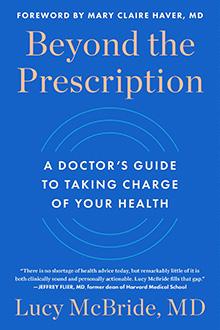
By the time McBride did find someone who listened and identified anxiety and depression as the underlying causes of her symptoms, McBride was a medical student at HMS, and the experience helped push her toward a career in primary care. After a residency at Johns Hopkins, she spent two years working as an internist in an emergency department in Baltimore, which reinforced her belief in the importance of access to effective primary care. “My colleagues and I weren’t just providing emergency care,” she writes in her new book, Beyond the Prescription: A Doctor’s Guide to Taking Charge of Your Health. “We were effectively serving as primary care providers for East Baltimore — treating diabetics who couldn’t afford insulin, asthmatics who’d never developed management plans, and elderly patients with urinary tract infections who lacked access to basic preventive care.”
In 2006, McBride joined a primary care practice in Washington, D.C., and in 2024, she cofounded her own direct primary care practice, also in Washington. Direct primary care clinics typically do not accept insurance, instead charging patients an annual fee for a set of services, and physicians usually see fewer patients than physicians do in conventional primary care clinics. Ideally, the reduced administrative burden and smaller roster of patients give physicians in direct primary care more time to spend with each patient.
McBride says this model helps her practice the type of care she has always wanted to practice and allows her to really get to know her patients. But she laments the fact that so many Americans don’t have a strong relationship with a primary care physician, and Beyond the Prescription is her attempt to help them. The book provides a framework to guide people in making decisions about their health and their health care. “It is designed to help you squeeze the most out of the medical system and to better advocate for yourself within it,” she writes. In other words, it’s the book McBride wishes she had when she was struggling to get the care she needed.
McBride talked with Harvard Medicine editor Amos Esty about the joys and frustrations of primary care, how to foster strong physician-patient relationships, and why she wrote her new book. This interview has been edited for length and clarity.
You have a newsletter, a podcast, and now a book. What got you interested in reaching a broader audience?
There’s one word for it: COVID. Before March 2020, I was going about my business, practicing medicine, seeing patients every day, raising three kids. Then the pandemic hit, and I realized that people are starved for trusted medical guides. As was the case for many doctors, my cellphone was ringing off the hook. What do I do? Where do I go? The average American doesn’t have a primary care doctor to call. They don’t know how to make decisions about risk, even basic decisions like, “Which vaccine should I get?” “Should I go to my daughter’s wedding or stay home?” It just was such a stunning reminder of how trust and guidance is essential — of course in a global pandemic, but also just in general for mundane health issues.
So I started writing a newsletter to my patients and my friends and family saying, “Here’s what I’m seeing. Take it or leave it.” I wrote every single day for 90 days, and it really caught on. That newsletter became a way for me to help people who didn’t have anyone to call, to help people beyond the walls of my office.
I’ve been writing ever since. Even during the pandemic, I wasn’t just writing about COVID. I was writing about health in a much broader way. I wanted to write a book to help people arm themselves with more information about how to make those decisions and how to understand their health in a more nuanced way. Health is not just about your labs once a year at your annual physical. Health is not just about 10,000 steps or a certain dietary protocol. Health care is really about a partnership — about helping people make decisions that are right for them.
Your book opens with a story about a woman who tells you that she’s basically given up on mainstream medicine. How often do you hear that? Has that changed over the years you’ve been practicing?
It’s only gotten worse. This is what I hear from readers of my newsletter. I think a lot of people have just given up entirely on health care. They’re cynical. They’re just so used to being seen as a transaction. They blame the system, but they also blame doctors. Even if you’re lucky enough to have a primary care doctor who’s in your insurance plan, if you call for an urgent matter, you might not be able to see that person for three months. So what do people want? They want access. They want someone to trust.
How much of that is an institutional or systemwide issue and how much comes down to individual relationships between doctors and patients?
I think the system, the structure of ambulatory care, is just not built for this kind of work. So even if you’re a good doctor and an empathetic person, it’s just impossible if you have 10 minutes. Studies have shown that doctors interrupt their patients, on average, in the first 11 seconds. And then we, as primary care doctors, spend two hours on our EHRs [electronic health records] for every hour of direct face time. Then you look at payments to primary care. I mean primary care, the setting where we’re supposed to be listening and asking the right questions, gets less than 5 percent of U.S. health care spending.
You write about asking your patients what health means to them. How did you start taking that approach to rethinking what health means?
I’ve always been interested in the human experience of illness. For example, at HMS, I loved the class where they hired actors to be patients and we had to establish a rapport with them and give them bad news. I loved the art of communication, of distilling complex information into understandable terms. I always liked the idea of transferring power — meaning knowledge and experience — from the doctor to the patient.
I’ve also been a patient myself. I mean, we all have, but I’ve been in that vulnerable place where you don’t know what’s going on and you’re pinning your trust on this other human and how scary that is and how desperate you are for someone to understand you and someone to listen.
The most important moment in my exam room is not when I write a prescription; it’s when the patient realizes I’m really listening. I’m listening to what they’re saying about their caregiver stress, their sexual dysfunction, their relationship with alcohol, their struggles with disordered eating. Those are the most important moments, because when someone notices you’re listening, then they can talk about the things that are actually driving the lab tests. That can’t happen in a 10-minute appointment. It also can’t happen without communication and trust between two human beings.
Has working in direct primary care changed your experience of practicing medicine?
It has. It allows me to have time to understand the whole person. I went into primary care because I was interested in disease, but I was mostly interested in the people who housed the disease. To understand the whole person takes time that you don’t have in a 10- or 15-minute visit. Also, it’s hard to build trust in quick, transactional visits. So I’m really practicing the medicine that I thought I was going to be practicing when I went to medical school to begin with. It’s just that our system is so broken in the United States, it’s very difficult for primary care doctors to have the time they need.
I used to feel like being in direct primary care was part of the problem, and I think it is in some ways. I also think it’s part of the solution if you can show what it looks like or could look like to care for patients in a more holistic, evidence-based way. Primary care should be a hub for problem-solving, not just a gatekeeping apparatus.
Within the current constraints, what do you think doctors can do to promote this type of care?
We need to train doctors how to do it. We need to train doctors how to sit with discomfort and just be quiet. I’m not great at that. I love talking. But it is really powerful if you can just put your pen down and let someone talk and let them surface the issue that they’re actually struggling with. That’s what I find meaningful. I mean, why are we alive if not to shepherd people through these moments? Health is just a proxy for life.
I also think we need to band together. I was just shocked during the pandemic how passive it felt like doctors were in this whole maelstrom. I think we could band together and demand that our system treat patients and doctors fairly and demand a payment system that rewards the cognitive and relational work of eliciting a patient’s needs, not merely the procedures and the prescriptions that come after it.
I think we can do that. If we can go to medical school and take MCATs and step one and two and boards, we can advocate for care. I also think you need medical schools to incentivize graduates coming out of medical schools to go into primary care fields. You’ve got to incentivize medical students because medical students are smart. They want to go into fields that are going to pay back their loans and provide them quality of life.
You wrote your book to help patients. But what do you hope clinicians who read your book take away from it?
Let’s say you’re a primary care doctor reading this book. I hope that it gives you some vocabulary with which to talk to patients about sensitive topics. Because I think sometimes the most important conversation we have is the conversation where we give patients permission to say the things that they might’ve been embarrassed to say out loud. I hope it gives them some tools to hand patients. It’s sort of like homework for the patient to bring back to the next appointment.
I hope it restores some primary care doctors’ faith in what primary care is, the art and the science of caring for human beings, because I think a lot of primary care doctors out there are really burned out and really disillusioned.
My fantasy is for this book to help patients feel more empowered and for this kind of medicine to be scaled more broadly, because I don’t think it should only be accessible to people who can afford it. I think this is what people want. They want someone who knows their name, not just their diagnosis codes. They want a rapport. They want to feel trusted and they want to be heard. We want the same thing. And there are ways we can really band together to advocate for this.