By Studying Fruit Flies, Rachel Wilson Is Changing How We Understand the Brain
Research on navigation in Drosophila melanogaster reveals fundamental principles about how nervous systems operate
- 15 minute read
- Feature
Rachel Wilson
Photo: Simon Simard

Rachel Wilson
Photo: Simon Simard
It’s a typical afternoon in the Wilson Lab. Graduate students and postdocs are scattered throughout the open space, peering through microscopes on lab benches, scanning multimonitor computer setups, working at specialized “fly rigs.” Bits of conversations create a constant, low hum.
The fruit flies — the dark, sesame-seed-sized stars of the show — are easy to miss at first. Each colony is contained in a glass tube with food at the bottom and a papery white stopper at the top. The insects cling to the sides, occasionally hovering in place or leaping to a new position. The tubes are stored upright in carefully labeled cardboard boxes stacked on every surface.
At the center of the action is Rachel Wilson herself, first huddled next to a fly rig, coaching a research technician step-by-step on how to insert an electrode into an individual neuron in a fruit fly brain to record electrical activity — a technique she pioneered in the early 2000s. Later, she works with a graduate student at a computer, offering suggestions as they carefully talk through the results of a recent set of experiments.
Wilson’s hands-on, highly engaged approach in the lab is one reason she has been able to tackle such big questions in neurobiology. Over the past 20-plus years, her detailed, mechanistic work in fruit flies has pushed forward an entire field of neuroscience by revealing fundamental principles of how nervous systems operate. “She’s one of these generational scientists who thinks extremely incisively about both the details and the big-picture frameworks,” says Yvette Fisher, a former postdoctoral fellow in Wilson’s lab who now leads her own lab at the University of California, Berkeley.
This ability has allowed Wilson, the Joseph B. Martin Professor of Basic Research in the Field of Neurobiology in the Blavatnik Institute at HMS, to pivot from studying olfaction and other sensory systems to navigation, and to venture into a newer field of neuroscience called connectomics — while making major contributions to each area along the way. “Rachel has a deeply ingrained internal compass that guides her toward new and amazing science,” says John Tuthill, also a former postdoc, who now leads a lab at the University of Washington.
But for all of the progress she has made, Wilson herself seems focused on what she doesn’t know. She describes the current state of neuroscience as a vast but somewhat disjointed collection of facts: Researchers have identified many key genes in neurons and figured out many of the functions of the proteins they encode, and they have linked brain regions to general processes such as memory, planning, and language. “But we still don’t really understand how neurons work together to implement the big tasks that the nervous system needs to do,” Wilson says. “We do not really understand for any organism how neurons give rise to thoughts and intelligent behaviors.”
It is clear that there is no end to the questions she wants to pursue — questions that move her ever closer to her overarching goal: figuring out how the basic building blocks of the nervous system work together to shape what an animal does. Eventually, she hopes to reveal the nervous system’s overarching logic, including how behavior arises from computations made by neural circuits. “Our goal is to understand the nervous system with the same level of detail and explicitness that an engineer seeks in trying to understand an electronic device that they did not design,” she says.
Sensory Systems
In 2002, two years into her postdoctoral fellowship at the California Institute of Technology, Wilson was feeling burned out. And for good reason: She was trying to study a locust species, but her experiments were frustrating. Even though Wilson had figured out how to make stable electrical recordings from individual neurons in a living locust, she couldn’t consistently target neurons of interest with those recordings. She was stuck. So, Wilson and another postdoc, Glenn Turner, now a group leader at Howard Hughes Medical Institute’s Janelia Research Campus, approached their advisor with a risky pitch: They would take a three-month hiatus from their projects to study fruit flies.
Fruit flies seemed promising because they readily perform many of their typical behaviors in the lab — likely because they’re opportunists that evolved to live alongside humans in a wide range of environments. Moreover, Norbert Perrimon, the James Stillman Professor of Developmental Biology at HMS, and his team had recently figured out how to insert yeast genes into fruit flies to label cells of interest with green fluorescent protein. Neuroscientists quickly adopted the approach and began developing strains of fruit flies in which specific neurons were labeled to glow green.
Our sense of body position is close to our notion of selfhood, so it’s an issue that touches on our fundamental sense of ourselves.
Suddenly, Wilson had a way of repeatedly targeting the same specific neurons in a fruit fly brain to record electrical activity — she just needed to place an electrode on the glowing green cells. Once she did that, she could monitor activity in those neurons in real time while presenting flies with various sensory stimuli. “Thoughts and behaviors unfold very rapidly, but by putting electrodes directly on neurons, we can record things that are superfast, which opens up all sorts of new questions,” Wilson says.
The technique that Wilson and Turner brought to fruit fly research, known as in vivo patch-clamp recording, or “patching,” was a technical breakthrough “that basically laid the path for our entire field,” Tuthill says. It became the foundation of research in Wilson’s future fly lab and many others.
Fruit flies have a storied history as a scientific model. In 1909, geneticist Thomas Hunt Morgan began breeding the fruit fly (Drosophila melanogaster) because of its rapid reproduction, large number of offspring, and ability to thrive in the lab. Soon his fly experiments had produced the first solid evidence that genes are located on chromosomes.
From there, scientists created thousands of specialized lines of fruit flies genetically modified to label different cells. In 2000, they published the first complete fly genome. In recent decades, research groups have focused on developing neuroscience-specific tools, including fly lines in which specific subsets of neurons are genetically labeled and a detailed wiring diagram of the entire central nervous system — a comprehensive list of neurons and their connections.
The fruit fly is a relatively simple organism, with a central nervous system made up of around 160,000 neurons (by contrast, the human brain has around 86 billion). This makes it feasible to understand a fly’s nervous system in its entirety. Yet despite their simplicity, fruit flies exhibit complex behaviors in the lab: They can learn about new environments, often returning to locations of interest based on memory; they also sing, fight, perform courtship rituals, and sleep.
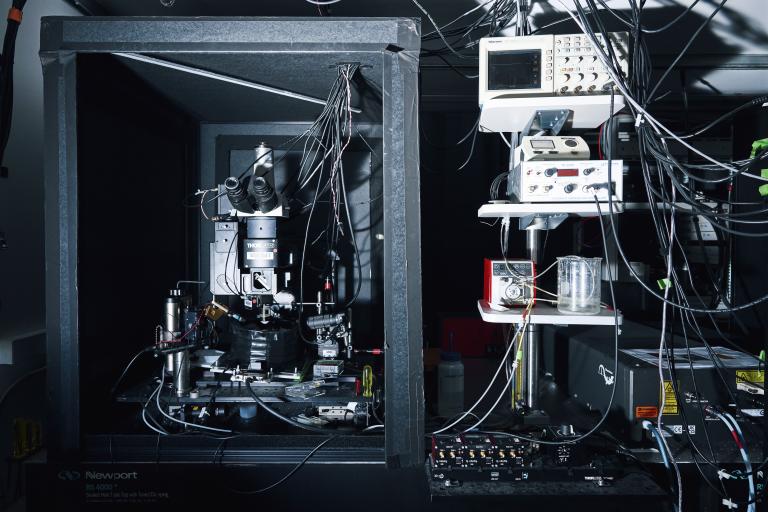
At the heart of Wilson’s research is what’s called a fruit fly rig (shown above): a complicated-looking apparatus consisting of a microscope, cameras, and various metal implements surrounding a fruit-fly-sized virtual reality setup. Most lab members have their own rigs tailored to their specific projects.
At the center of the rig, a fly is tethered in place while it walks on a small ball — a spherical treadmill floating on air. As the fly alters its speed and direction, sensory cues move in sync with the insect to give it the impression that it is navigating through the world. Often, these cues are in the form of visuals projected onto a panoramic screen, or sometimes as wind or odors piped in at antennae level. At the same time, researchers use two main approaches to record activity from genetically labeled neurons in a fly’s brain.
The first is the patching technique that Wilson developed, in which an electrode is placed on an individual neuron and directly records electrical activity from that neuron, which spikes when the cell becomes active. The second is a technique that involves pumping photons into the fly brain, where a specific population of neurons has been modified to light up when calcium — a proxy for electrical activity — enters the cells as they become active.
Together, the techniques offer the fine-scale precision of studying activity at the single-neuron level and the broad perspective of watching activity in an entire population of neurons. The researchers also use optogenetic and chemistry-based techniques to perturb neural networks — activating, silencing, or disrupting neurons to see how the fly responds.
“Our specialty is to design and interpret tricky experiments that allow us to observe neural activity in fruit flies and correlate it with their behavior,” Wilson says. “We know what a fly is thinking not just based on what they do in the environment but also based on watching activity in their brain.”
Photo: Simon Simard
When Wilson launched her lab at HMS in 2004, the tools for studying neurons in fruit flies were limited to a few hundred genetic lines — covering only a fraction of the fly’s 160,000 neurons — and incomplete wiring diagrams. At first, her focus was on the flies’ sense of smell. “The olfactory system has a really orderly organization that made it pretty easy to come up with hypotheses, even if we didn’t have many genetic tools and didn’t understand how all the neurons were connected,” Wilson says. The lab discovered that many of the same principles govern the architecture of olfactory systems in both fruit flies and mammals, even though fruit flies detect odors with antennae and mammals use a nose. For example, in both cases, olfaction starts with odor molecules in the environment binding to receptors in the antennae or nose. The signals from those receptors are pooled together in the brain, allowing the organism to quickly and accurately sense the odor.
Over time, as the number of genetic lines increased, the Wilson Lab expanded to more sensory systems, including hearing. Again, the researchers found evidence of overlap between fruit flies and mammals — this time in the form of the map of auditory space in the brain, which for both consists of different stripes of brain space that correspond to different sound frequencies. “Even though some of the details are really different, the basic principles are remarkably similar,” Wilson says, illustrating how evolution can independently “solve” problems the same way in unrelated lineages — a process called convergent evolution.
Turning Toward Navigation
After nearly a decade of studying sensory systems in fruit flies, Wilson pivoted to studying a different type of behavior: navigation. Wilson defines navigation as purposeful locomotion through space. The topic initially attracted her because it is easy to get fruit flies to navigate in the lab. Moreover, their movements can be completely captured by simple measurements such as speed, distance, and direction. Perhaps most importantly, researchers can get a sense of what a fly is thinking based on where it goes.
“Navigation is a way to study thought by studying behavior,” Wilson says. “When you watch a fruit fly navigate in virtual reality while tracking its neural activity, you can literally see in its brain the moment it becomes confused or decides to change direction.”
Fisher, who has continued studying fruit fly navigation in her own lab, sums up the two big questions driving the research: “Where am I? And given that, where should I go next?” Traditionally, Fisher says, learning experiments in neuroscience have centered on training an animal to do a specific task a specific way. By contrast, navigation is a form of unsupervised learning — learning in which there is no right or wrong answer. Thus, she thinks navigation could provide a foundation for understanding more complicated unsupervised learning tasks performed by other species or even machine-learning systems.
To date, one of the Wilson Lab’s biggest contributions to understanding navigation in fruit flies relates to the internal compass that underpins a fly’s sense of direction. In parallel with other labs, the team characterized the navigation regions of the fruit fly brain, which house a group of specialized neurons, aptly named “compass” neurons, arranged in a circle. Much like a physical compass, these neurons track which way a fly is pointed — for example, north versus south. What this looks like, Wilson says, is a hot spot of neural activity that moves around the compass based on a fly’s current orientation. Wilson and Fisher showed how the compass can anchor to visual landmarks so that it accurately tracks the fly’s orientation over time. In later work, Wilson and colleagues found that the compass can anchor to wind direction and that it can rapidly learn the arrangement of different landmarks in an environment.
Wilson also discovered two other types of navigational neurons that track the direction a fly is moving in the environment to create a map of travel direction in the brain. The hot spot of activity in this “travel map” is the same, regardless of whether the fly is pointed north and moving forward, or whether it is pointed south and moving backward: In both cases, it is traveling north. In this work, Wilson turned to collaborators at Caltech who designed behavioral experiments in which a fly walks around a circular maze searching for a reward it had previously found. Interfering with the inputs to the “travel map” prevented a fly from finding the reward again, further revealing how this system helps the fly navigate through space.
“This research shows how the brain can keep track of the direction you’re moving in, regardless of the direction you’re facing,” Wilson says. “It suggests a remarkably elegant and simple solution to what seems like a complicated problem.”
Head-direction cells — the non-insect equivalent of compass neurons — have been identified in a wide range of other animals, including rodents, bats, primates, and birds. Recently, other researchers applied similar methods to studying navigation in zebrafish. They discovered that the fish have an internal compass system that works much the same way as it does in fruit flies. “This is a really exciting finding because it means that a vertebrate is navigating in a similar way,” Fisher says.
Wilson adds that it’s becoming increasingly clear that sense of direction in insects and mammals has the same basic organization, and so the principles of navigation her lab is uncovering in fruit flies may be directly relevant to various mammal species.
The big question, Wilson acknowledges, is how navigation in fruit flies relates to humans. She points out that scientists don’t yet fully understand how navigation works in humans, including how humans perceive their body position in space. Therefore, it’s impossible to say exactly what will be similar in the human and insect navigation systems. That said, Wilson is betting that there are some important similarities. In humans, problems with spatial navigation and body sensing can be an early sign of certain neurodegenerative disorders, and so any clues from fruit flies may prove valuable in helping clinicians to understand what goes wrong when patients lose their sense of space.
“Our sense of body position is close to our notion of selfhood, so it’s an issue that touches on our fundamental sense of ourselves,” she says.
The Wilson Lab is also studying other facets of fruit fly navigation. In a 2024 Nature study, the researchers described how the compass and steering regions of the brain work together. They uncovered three groups of neurons that help a fruit fly correct its path after being knocked off course: one that nudges it to the right, another that nudges it to the left, and a third that tells it to turn around completely.
Another project is investigating the role of dopamine in a fly’s internal compass. The researchers discovered that when a fly enters a new environment, dopamine floods into its compass neurons as it moves around, priming the compass to be quickly recalibrated based on new directional cues. The findings suggest a new function for dopamine in the brain, beyond its established involvement in motivation and learning. Now, doctoral student Pablo Reimers is studying a type of neuron that seems to play a central role in this recalibration process.
“We think this is a way to link learning to action so that the compass system can be plastic and flexible when new information becomes available,” Wilson says.
As the Wilson Lab and other researchers continue to fill in the details of fruit fly navigation, Wilson expects that a complete picture of the behavior will begin to emerge. “I think we’re going to have a satisfying understanding of the logic that organizes navigation within my lifetime, and that will be a huge achievement for the field,” Wilson says.
Connecting Connectomes
Wilson first began collaborating with Wei-Chung Allen Lee, an associate professor of neurobiology at HMS and associate professor of neurology at Boston Children’s Hospital, over a decade ago, when Lee’s field — connectomics — was taking off. Connectomics involves creating maps of all the connections between neurons in the nervous system, and the compact nervous system of a fruit fly was a natural fit.
“It’s hard to overstate how well connectomics has slotted into all the amazing fruit fly anatomy and genetic tools,” Fisher says. “People were already labeling really precisely defined neurons, and when connectomics came, those things linked up.”
Starting with the olfactory system, Wilson and Lee began creating fruit fly connectomes — comprehensive wiring diagrams of the connections between neurons. Recently, Wilson, Lee, and a large international team of collaborators published the most complete fruit fly connectome to date: a map of all the connections between neurons in a fruit fly central nervous system (which includes its brain and connected spinal cord equivalent, called a nerve cord).
Previously, Wilson says, researchers had produced separate connectomes of a fruit fly brain and nerve cord but hadn’t combined them. “We were basically looking at a disembodied brain,” Wilson says. “Putting the two together and seeing the organization of the whole central nervous system was a revelation.”
The research is changing the way Wilson and other fruit fly researchers approach their work. Now, they use the connectome as a starting point to make detailed predictions about neurons and neural circuits and design experiments that test those predictions. “Basically, researchers go to the connectome, find their neurons of interest, look at all the inputs and outputs, and form new hypotheses,” Lee says. “The connectome is a hypothesis-driving engine because everything is there — as others have also said, there are no neurons that can be overlooked.”
A Challenging Finding
With a connectome of the fruit fly central nervous system in hand, Lee and Wilson agree that the future research directions are endless. To begin, they have started to analyze the patterns of neural connectivity that produce coordinated control of all “output cells” of the nervous system — namely, motor neurons, internal organs, and endocrine cells.
What they found surprised them. Instead of being controlled by some higher-level brain region — a centralized controller, or what Wilson calls the “flyunculus,” in a nod to the human homunculus — all of these output cells are most influenced by sensory signals in the same body part. For example, the motor neurons that control feeding are most influenced by sensory cells in the mouth region, whereas the motor neurons that control a specific limb are most influenced by sensory cells in that limb. Coordinated behavior seems to emerge from interactions between local modules. “What’s clear from our anatomical analyses is that there is no flyunculus,” Wilson says. “The main influences on any body part are the local signals from that body part, and high-level brain regions are not required for most actions.” Wilson and Lee think that the higher-level regions of the brain, such as the navigation regions Wilson studies, are essentially “supervising” behavior rather than directly driving it.
I’m just not sure that we, as neuroscientists, have fully grappled with the implications of what we already know.
Wilson draws an analogy to a large manufacturing company: Decisions about changing the speed of a machine on the production line are primarily made by the operator, with some influence from the next operator over. The middle manager might indirectly weigh in on the decision, and the CEO would only make a loose suggestion.
The finding highlights the power of studying fruit flies, Wilson says, in that researchers now have a complete wiring diagram of the central nervous system and the tools to watch activity in almost any brain region. “It’s all in front of you — there’s nowhere to hide. You can’t fool yourself by saying ‘Well, this brain function probably happens somewhere else,’” Wilson says.
Wilson adds that she tends to think about her identity as being tied to a homunculus that lives in her brain — a little person making decisions about what she should do next. So she finds the idea of decentralized decision-making somewhat destabilizing. “Looking at the fruit fly nervous system, it’s pretty clear that there is no ‘me,’ which actually threatens my sense of who I am,” she says.
If decentralized control doesn’t turn out to apply to humans and other species, then Wilson wants to know where in the animal kingdom a centralized sense of self emerges. And if it is confirmed more broadly, it may signal something even bigger for the field.
“Forcing ourselves to be very explicit about what we think might be happening here is intellectually bracing in a way that you cannot imagine,” Wilson says. “I’m just not sure that we, as neuroscientists, have fully grappled with the implications of what we already know.”
It’s yet another example of how Wilson and other fruit fly researchers are moving closer to a broader goal: understanding the fruit fly in its entirety by characterizing its every neuron, connection, and behavior. “I think when we’re done, it will change how we as humans understand ourselves,” she says. “It’s profound, and I feel proud to be contributing to this effort.”
Catherine Caruso is a senior science writer and editor in the HMS Office of Communications and External Relations.